
Firearms Owners Against Crime
Institute for Legal, Legislative and Educational Action
Institute for Legal, Legislative and Educational Action
Fairfax, VA -(AmmoLand.com)- A recent report from NationalJournal.com demonstrates why increasingly frequent “studies” from media organizations, claiming to validate one or another anti-gun viewpoint, should be recognized for the agenda-driven pablum that they are.

On August 28, the website published an article by graphic artist Libby Isenstein, the thesis of which is evident in its title, The States With The Most Gun Laws See The Fewest Gun-Related Deaths.
Isenstein set the tone of her article at the outset, repeating an anti-gun website’s claim that there have been “more than 200 mass shootings in 2015.” In doing so, however, Isenstein forfeited any credibility she might otherwise have been assumed to possess. With a few seconds of research, she could have determined that only 14 percent of the firearm-related incidents currently cited by the website were “mass shootings,” traditionally defined as murders, with a firearm, of four or more victims, in a single incident, in close geographical proximity. Thirty-seven percent of the incidents had no fatal victims whatsoever. She could have also found leading criminologist James Alan Fox’s recent assessment, following a review of the most comprehensive study of mass shootings to date, that the report “should calm the fears that many people have that these numbers are out of control” and that “No matter how you cut it, there’s no epidemic.”
Isenstein confined the rest of her article to comparing gun control and firearm-related deaths, but she made so many mistakes that we feel we should apologize in advance for the length of our response, which follows.
Even with the states properly categorized, no comparison involving the numbers of homicides taking place in Stand Your Ground states would have value unless defensive homicides were counted separately from the criminal variety and, among a statistically valid sample of defensive and criminal homicides in Stand Your Ground states, it were determined whether the persons who committed the homicides claimed to have done so under the protection of Stand Your Ground laws.
Isenstein also incorrectly characterized as a “loophole” the absence of a background check requirement on private transfers of firearms. Had she researched the matter, she would have learned that the federal Gun Control Act of 1968 imposed recordkeeping and similar requirements upon firearm dealers, and extended that requirement to background checks beginning in 1994, but has never imposed such requirements upon private individuals. In proposing background checks on private firearm transfers, gun control supporters aren’t trying to “close a loophole,” they’re trying to create, at the federal level and in many states, an entirely new form of regulation and data-keeping on gun buyers where none existed before.
Furthermore, Isenstein claimed that “an estimated 40 percent of gun sales in this country are made via unlicensed sellers.” This suggests that Isenstein should spend more time reading the news than trying to create it, because the “40 percent” claim has been discredited by the Washington Post here, by the Richmond Times-Dispatch here, and by FactCheck.org here, over a period of several years, and it has been disavowed by the authors of the study on which gun control supporters nevertheless continue to pretend their bogus claim is based.
Isenstein also parroted gun control supporters’ misleading claim that background checks aren’t required on people who purchase guns “online.” As we have said many times, federal law, 18 U.S.C. 922(a)(3) and (5), prohibits a person who is not a licensed dealer from providing a gun to a non-dealer resident of another state, and prohibits a person who resides in one state from receiving a firearm from a non-dealer who resides in another state, unless the transaction goes through a dealer, at which point a background check will transpire.
Isenstein also mentioned gun shows and in this instance we have to give credit where credit is due. Whereas gun control supporters claim that background checks aren’t currently required on any firearm sales at gun shows, Isenstein correctly made clear that firearm dealers are already required to conduct checks at shows.
We categorized the states correctly and, to get hard numbers for every state for 2013 (rather than excluding 11 states, as Isenstein did), we performed calculations using superior data published by the FBI. In doing so, we found that in 2013, Right-to-Carry states had a 20 percent lower total murder rate. We also ranked the states and the District in terms of their murder rates, and found that those with restrictive firearm carry laws had among the highest and lowest, and had some in the middle of the ranking. Where the restrictive group is concerned, the District had the highest rate and, among the states, Maryland ranked 4th, Illinois 11th, California 21st, New Jersey 22nd, Delaware 24th, New York 30th, Rhode Island 33rd, Massachusetts 42nd, and Hawaii 49th.
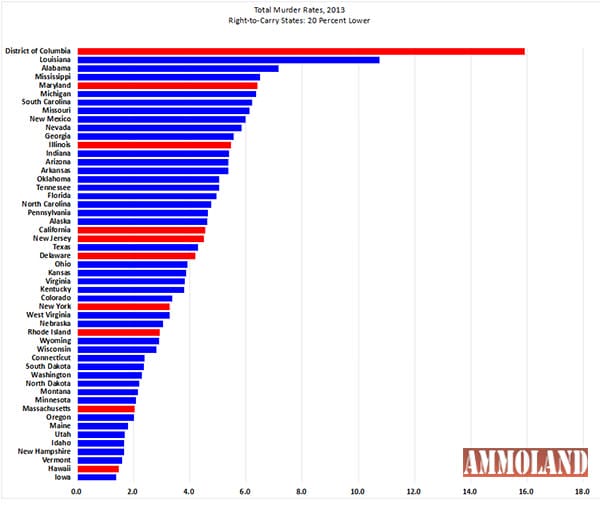
Graph 1
We also found that Right-to-Carry states had a 29 percent lower firearm murder rate, as compared to the restrictive group. We should note, the second calculation was slightly problematic, in that in 2013, Alabama reported the weapon used in only a very small percentage of its murders and Florida reported the weapon for none. For those states, we assumed that 69 percent of each state’s murders involved firearms, based upon the FBI’s reporting of that figure nationally for 2013. For any other states that reported less than 100 percent, we used simple projections based upon the reports they submitted.
Again the restrictive group ranked high, in the middle, and low. The District again ranked highest and, among the states, Illinois ranked 5th, Maryland 6th, Delaware 12th, New Jersey 19th, California 22nd, New York 30th, Rhode Island 33rd, Massachusetts 39th and Hawaii 43rd.
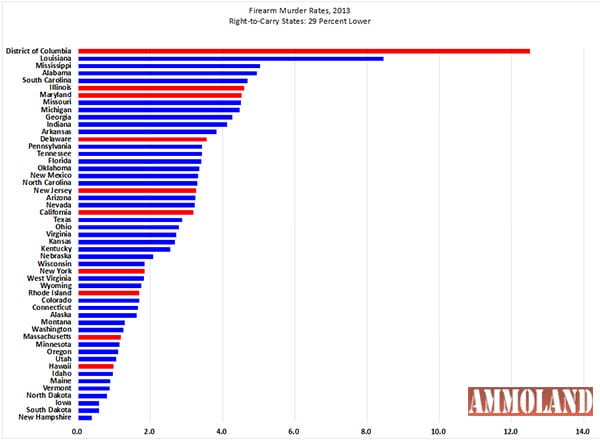
Graph 2
We categorized the states correctly and recalculated, using the FBI’s firearm murder data. We found that the average total murder rate of the states that haven’t imposed expanded background checks on handgun purchasers was seven percent lower than that of the background check group. Among the background check group, the District again ranked highest, and among the states Maryland was 4th, Michigan 5th, Illinois 11th, North Carolina 18th, Pennsylvania 19th, California 21st, New Jersey 22nd, New York 30th, Nebraska 32nd, Rhode Island 33rd, Connecticut 36th, Minnesota 41st, Massachusetts 42nd, Hawaii 49th, and Iowa 50th.
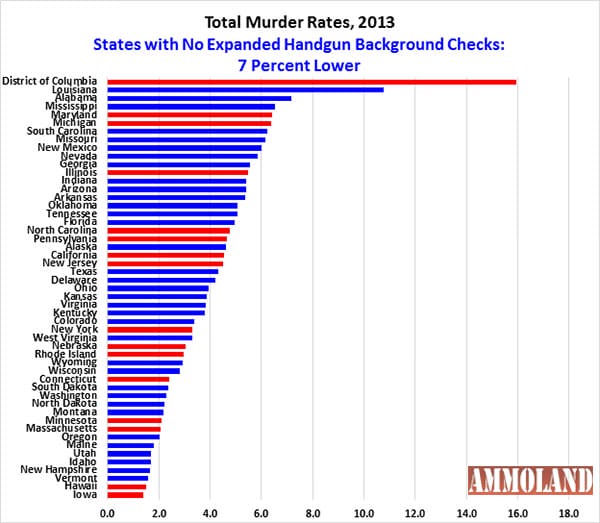
Graph 3
We also found that the average firearm murder rate of the less restrictive states was 14 percent lower. The District again ranked highest and, among the states, Illinois was 5th, Maryland 6th, Michigan 8th, Pennsylvania 13th, North Carolina 18ths, New Jersey 19th, California 22nd, Nebraska 28th, New York 30th, Rhode Island 33rd, Connecticut 35th, Massachusetts 39th, Minnesota 40th, Hawaii 43rd, and Iowa 48th.
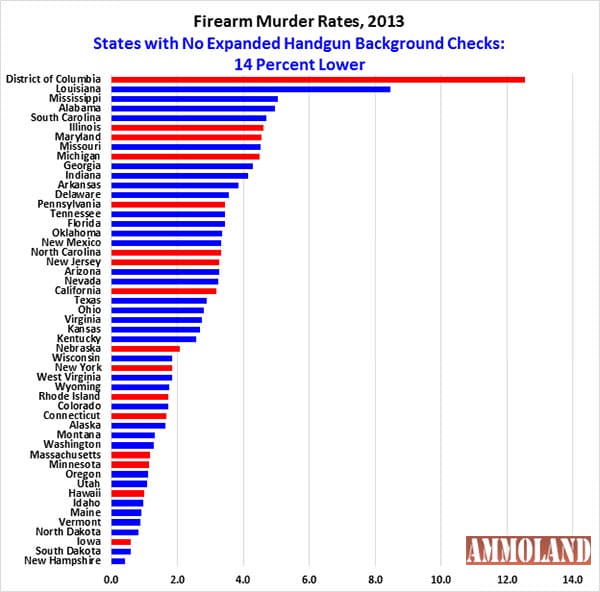
Graph 4
In the future, we hope everyone will take as critical a look at anti-gun “studies” as we have with this one. Doing so would ultimately save a lot of Americans’ time and energy, currently being wasted and distracted by anti-gun culture warriors masquerading as investigative journalists.
About the NRA-ILA:
Established in 1975, the Institute for Legislative Action (ILA) is the “lobbying” arm of the National Rifle Association of America. ILA is responsible for preserving the right of all law-abiding individuals in the legislative, political, and legal arenas, to purchase, possess and use firearms for legitimate purposes as guaranteed by the Second Amendment to the U.S. Constitution.